Guides · Sharing money
How to split bills with roommates, without anyone keeping score.
Almost nobody falls out over the arithmetic. They fall out over the six weeks between the shop and the transfer, when one person remembers a number and the other remembers a different one.
First
Three ways to split, and when each one is actually fair.
Pick one deliberately, say it out loud once, and stop revisiting it. Most household friction comes from two people quietly using different methods.
Down the middle
Everyone pays the same share. It is the easiest to keep and the easiest to trust, and for rent, internet and anything nobody can use more of, it is simply right. It stops being fair the moment one person is away half the month or one person owns the car.
By what each person uses
Groceries where one person eats at home and the other does not. A car one person drives. This is the fairest method and the most expensive to run, because somebody has to keep the record. It only survives if recording takes seconds — if it takes a spreadsheet, it will be abandoned in a month.
In proportion to income
Common between partners, rare between flatmates, and worth naming as an option rather than letting it happen by accident. If one person earns twice as much and quietly pays for more, that is this method — it works far better when it has been agreed than when it is simply endured.
The part that causes the arguments
It is the settling, not the splitting.
A shared bill has two separate halves, and people run them together. The first half is what is each person’s share — arithmetic, settled in seconds. The second half is who has paid whom, and how much is still owed — and that half runs for weeks, across a dozen shops, in two people’s memories.
Nearly every household argument about money is the second half. One person is sure they sent forty last month. The other is sure that forty was for something else. Neither is lying; there was simply never a record, and a memory of a number is not a record.
A rule that removes most of it
One person pays. Everyone records. Settle rarely.
Do not try to split at the till. Splitting a card payment four ways in a shop is slow, annoys the queue, and produces four receipts that nobody keeps. Let one person pay the whole thing, and record the split straight away instead.
Then let the balance run. Resist the urge to send four dollars every time. A running balance that is settled once a month is fewer transfers, fewer fees, and — more importantly — one number to agree on instead of thirty.
Two things make this work, and without them it collapses:
- The record is made the same day. Not at the weekend. A receipt photographed in the car park is a fact; a receipt remembered on Sunday is an estimate.
- Everyone can see the balance. If only one person can see it, it is not a shared record, it is one person’s claim — and that is exactly the thing the other person doubts.
The awkward case
The shared shop that was not entirely shared.
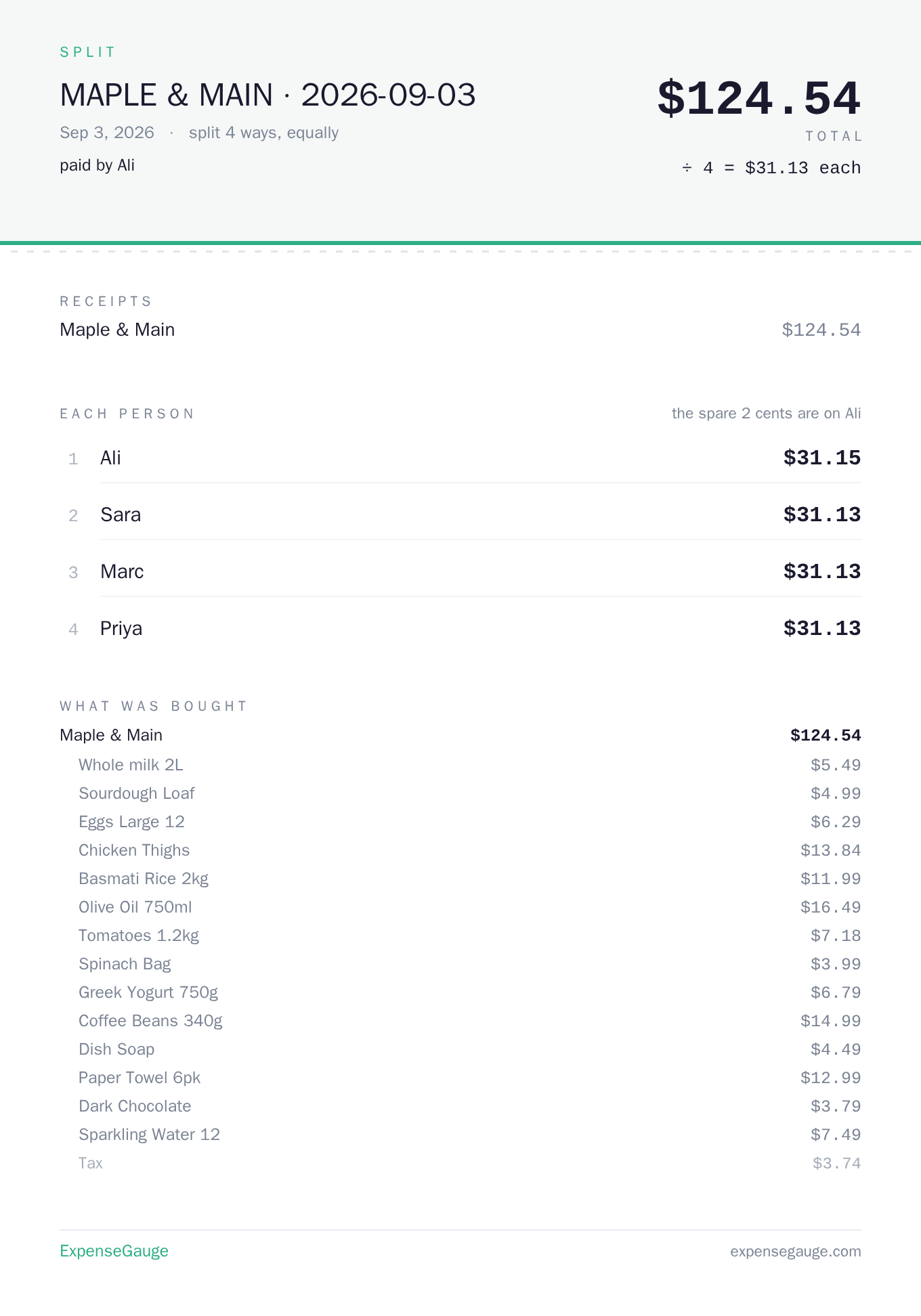
One trolley, one receipt, and three of the forty items are one person’s. This is where households give up, because pulling three lines out of a receipt by hand is tedious enough that people stop bothering and quietly accept a small unfairness every week.
Small unfairness every week is not small. Ten dollars a week is over five hundred a year, which is a real amount to be resentful about.
The answer is not to split the trolley in the shop. It is to keep the receipt’s own lines, so the three that are yours can be lifted out afterwards in a few seconds and the rest divided as usual.
And when somebody leaves
Close the balance on the day they move, not later.
A balance that is still open when somebody has moved out is the hardest money in the world to collect, and the most likely to end a friendship. On the day the keys are handed back, agree one final number and settle it, even if it is rough. A rough number that is closed beats an exact number that stays open.
If a bill is going to arrive after they have gone — a final electricity reading, a last internet month — estimate it and settle the estimate. Chasing thirty dollars from somebody in another city costs more than thirty dollars.
Straight answers
Questions people actually ask.
Should we get a joint account for shared bills?
It suits a household with steady, predictable bills — rent, utilities, internet — and it suits day-to-day shopping badly, because a joint card removes the record of who bought what. Many households run both: a joint account for the fixed bills, and a shared record for everything else.
How often should we settle up?
Once a month, on a fixed day, is the usual sweet spot. Weekly creates a stream of tiny transfers that nobody checks. Quarterly lets the balance grow large enough to be frightening, which is when people start disputing old entries.
What if one person always pays and never asks for it back?
Record it anyway. An unrecorded favour is only a favour while both people remember it the same way. Recording it does not force anyone to collect — it just means the generosity is visible rather than assumed.
Do we need everyone to use the same app?
No, and insisting on it is usually what kills the habit. One person keeping the record properly, where the others can see it, works. Four people half-keeping four records does not.
What about a bill in another currency?
Agree the rate once, at the moment you record it, and keep that rate with the entry. Converting again later at a different rate is how a settled balance quietly stops matching.
Where ExpenseGauge fits
It keeps the second half for you.
ExpenseGauge was built around the receipt rather than around the transfer, which is why it can do the awkward case: it reads the slip line by line, so the three items that were only yours can be taken out of the split instead of quietly rounded away.
The rest follows from that. A bill is shared with the people on it, each share is shown to everyone, paying somebody back is recorded rather than remembered, and a share can never be cut below what that person has already handed over. When somebody has paid too much, it says so in words rather than leaving it to be worked out.
No password. You sign in with a six-digit code sent to your email. The free plan is not a trial — see pricing.