Guides · Starting a budget
How to make a budget you will actually keep.
Most budgets do not fail because the numbers were wrong. They fail in the third week, when filling them in has become a chore and nobody remembers what the plan was. A budget you keep is smaller than the one you imagine: one honest number, set once, and a way of seeing it without doing arithmetic.
Why budgets are abandoned
The plan is fine. The bookkeeping is what people give up.
A typical first budget has twenty lines, a column for every week and a promise to type in every purchase. It works for nine days. Then a busy weekend goes by without an entry, the gaps make the totals meaningless, and the whole sheet quietly stops being opened.
So the first decision is not how much to spend on groceries. It is how little work the budget can ask of you and still tell you the truth. Everything below follows from that.
Step one
Take the fixed costs out first.
Rent, the phone bill, insurance, the transit pass, the subscriptions you mean to keep. They arrive whether or not you think about them, and they never come with a receipt, which is exactly why they get left out of budgets and then make the budget look wrong.
Write each one down once, with the day of the month it is paid. That list is not a decision you make every month; it is a fact about how you live, and it changes perhaps twice a year.
What remains of your monthly income after those, and after whatever you have decided to save, is the money you actually choose how to spend. That is the only part a budget can help with.
Step two
Give the month one number.
Not twenty categories with twenty limits. One figure for everything you buy in a month that is not a fixed cost: food, eating out, getting around, the pharmacy, the hardware store, presents.
If you have no idea what that figure should be, do not guess. Spend one ordinary month writing nothing down except your receipts, and let that month tell you. A number taken from your own life is one you can defend; a number from an article about an average household is not.
Then make it a little smaller than what the ordinary month showed, if you want to spend less. A little, not a lot. A figure you cannot possibly meet is abandoned faster than no figure at all.
Step three
Turn it into a figure for today.
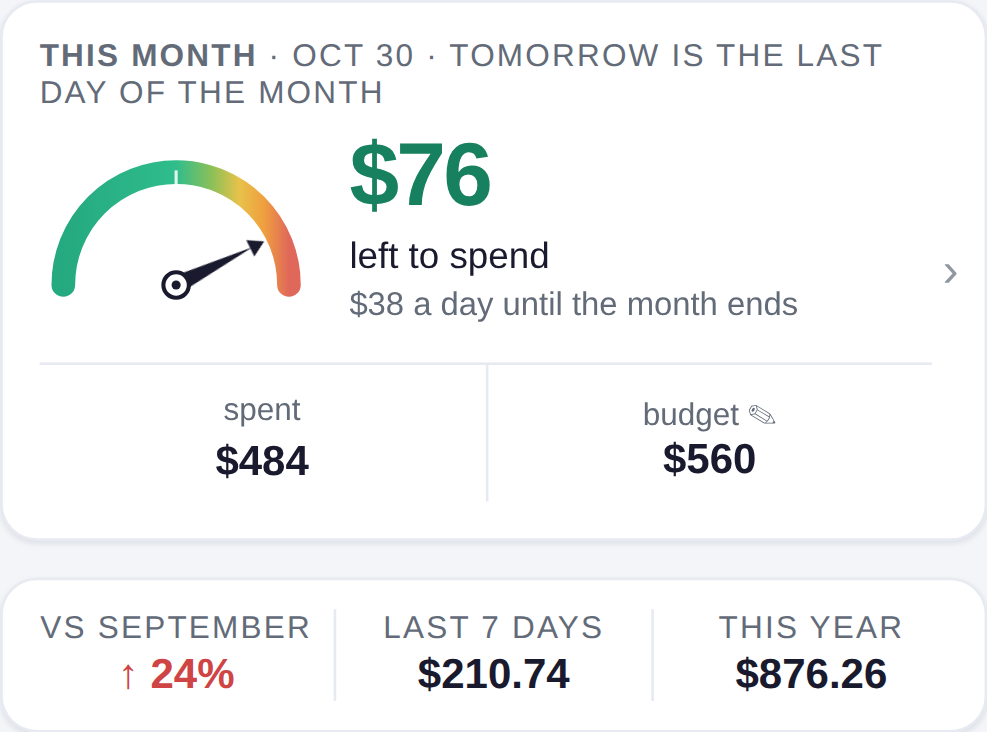
A monthly number is hard to feel on a Tuesday. Divide what is left by the days that are left, and you get the figure a decision is actually made with: if it says $38 a day, a $90 dinner is not forbidden, but you know what it costs the rest of the week.
This is also what makes a budget survive a bad week. A month that went over by Friday is not ruined; the daily figure simply gets smaller, and it shows you the way back without any recalculation.
Step four
Keep the record without typing it.
The record is the part that needs to cost almost nothing. Photographing a receipt at the till takes a few seconds; typing its lines into a sheet takes minutes and gets postponed. Keep the receipt photos and, once a month, the bank or card statement, which catches everything that never had paper.
Once the record exists, look at it by category on a day of your choosing in the middle of the month, not at the end. Our guide on where the month went covers how to read it.
List the fixed costs once
Each with its amount and the day it is paid. Change the list only when your life changes.
Set one number for the rest
Taken from an ordinary month of your own, then trimmed a little if you want to spend less.
Watch the daily figure
What is left, divided by the days left. It is the only budget figure shaped like a decision.
Photograph, do not type
Receipts as you go, the statement once a month. Nothing to fill in.
Straight answers
Common questions
Should I use the 50/30/20 rule?
As a starting point it is reasonable, but it was made for an average income in an average city. If your rent alone is more than half of what you earn, the rule tells you nothing useful. Your own ordinary month is a better guide.
Do I need a category for everything?
No. Categories are for understanding, limits are for changing behaviour. Put a limit only where you mean to change something, and let the rest simply be counted.
What if my income changes from month to month?
Base the month on your lowest ordinary month, not your best one. In a good month the extra goes to savings or to a slower month later, instead of quietly becoming spending.
What do I do when I go over?
Nothing dramatic. Look at whether it was a one-off that has already happened or a habit that will happen again. Only the habit needs a change; the one-off needs nothing.
Is a budget template enough?
A template is a good place to write the plan. It is a poor place to keep the record, because the record is what you stop updating. Keep the plan in one figure and let the record build itself from receipts and statements.
Where ExpenseGauge fits
One figure, set once, and the arithmetic done every day.
ExpenseGauge takes your fixed costs as single lines and counts each in the month it is due. You give the month one figure; it reads every receipt you photograph and every statement you send, files each item into a category, and shows what is left and what that comes to a day.
Nothing is typed, and the month is visible on the 12th, not the 31st.
No password. You sign in with a six-digit code sent to your email. The free plan is not a trial — see pricing.