Guides · Bank statements
Your statement already holds most of your month.
Rent, the gas bill, a subscription, the coffee you tapped for: none of them hand you a receipt, and all of them are on your statement. Read the right way, one page a month tells you more about where your money goes than a drawer full of slips.
What it shows
A date, a name and an amount. That is the whole line.
Every purchase on a statement is reduced to three things: the day it was paid, a merchant name, and an amount. That is enough to count it and usually enough to say what kind of spending it was.
The name is the hard part. Banks put their own words in front of it, cut it short, and sometimes print the company that processes the payment instead of the shop. A line that reads like a code is often a familiar place; searching the name once is usually enough, and after that you will recognise it every month.
What it hides
A statement knows the total, never the basket.
A single grocery line can hold food, soap and a birthday present. The statement files all of it under one name, so on paper it all looks like groceries. Where it matters, the receipt is what tells you what was inside.
Cash is the other gap. Money taken out of a machine shows up once, as a withdrawal, and then disappears from the record. If you spend a lot in cash, those purchases only exist on their receipts.
The two traps
Two kinds of line make people count money twice.
The first is the payment from your bank account to your credit card. It looks like a large expense, but the money was already spent, line by line, on the card. Count the purchases on the card statement and leave the payment out, or the same month is counted twice.
The second is money moved between your own accounts, to savings or to a joint account. It leaves one account, but it has not been spent. Money sent to another person is different: rent paid by transfer, a share of a dinner, a babysitter. That is spending, even without a shop name.
Deposits are the easy part. A salary or a transfer you received is money coming in, not spending, and does not belong in what you spent.
Receipts and statement together
The same purchase should be counted once.
If you photograph receipts and also go through the statement, the purchases you photographed appear on both. Match them by date and amount and keep the receipt, because it has the detail. Card payments often land a day or two after the receipt date, so allow for that.
Statements also overlap at the edges: this month’s page often repeats the last days of the one before. The same date, name and amount appearing twice across two statements is one purchase, not two.
In practice
A routine that takes minutes, once a month.
Download the statement
The PDF from your bank, or a photo of the page. One for the account, and one for each credit card.
Strike out what is not spending
Deposits, transfers to your own accounts, and the payment to your credit card.
Strike out what you already have
Purchases you photographed at the till, and lines repeated from last month’s page.
Put what is left into a few categories
Housing, food, eating out, getting around, everything else. Five honest groups say more than twenty careful ones.
Straight answers
Common questions
Is the statement enough on its own?
For knowing roughly where the month went, often yes. For knowing what was in a large grocery bill, for returns and for warranties, you still need the receipt.
Should I connect an app to my bank instead?
That is a choice about trust. A live connection needs access to your banking login or a permission granted through your bank. Sending the statement yourself means nothing has that access, at the cost of doing it once a month.
What about a refund?
A refund from a shop is money back, so it comes off what you spent. It is not income, and it is not a new purchase with a minus sign in front of it.
How far back should I go?
Three months is enough to see what is usual for you. Further back is history; it rarely changes what you would do next month.
A line on my statement makes no sense. What is it?
Search the merchant name exactly as it is printed. It is often the company that processed the payment for a shop you know. If you still cannot place it, call your bank: an unknown charge is worth one phone call.
Where ExpenseGauge fits
It reads the statement and leaves out what is not spending.
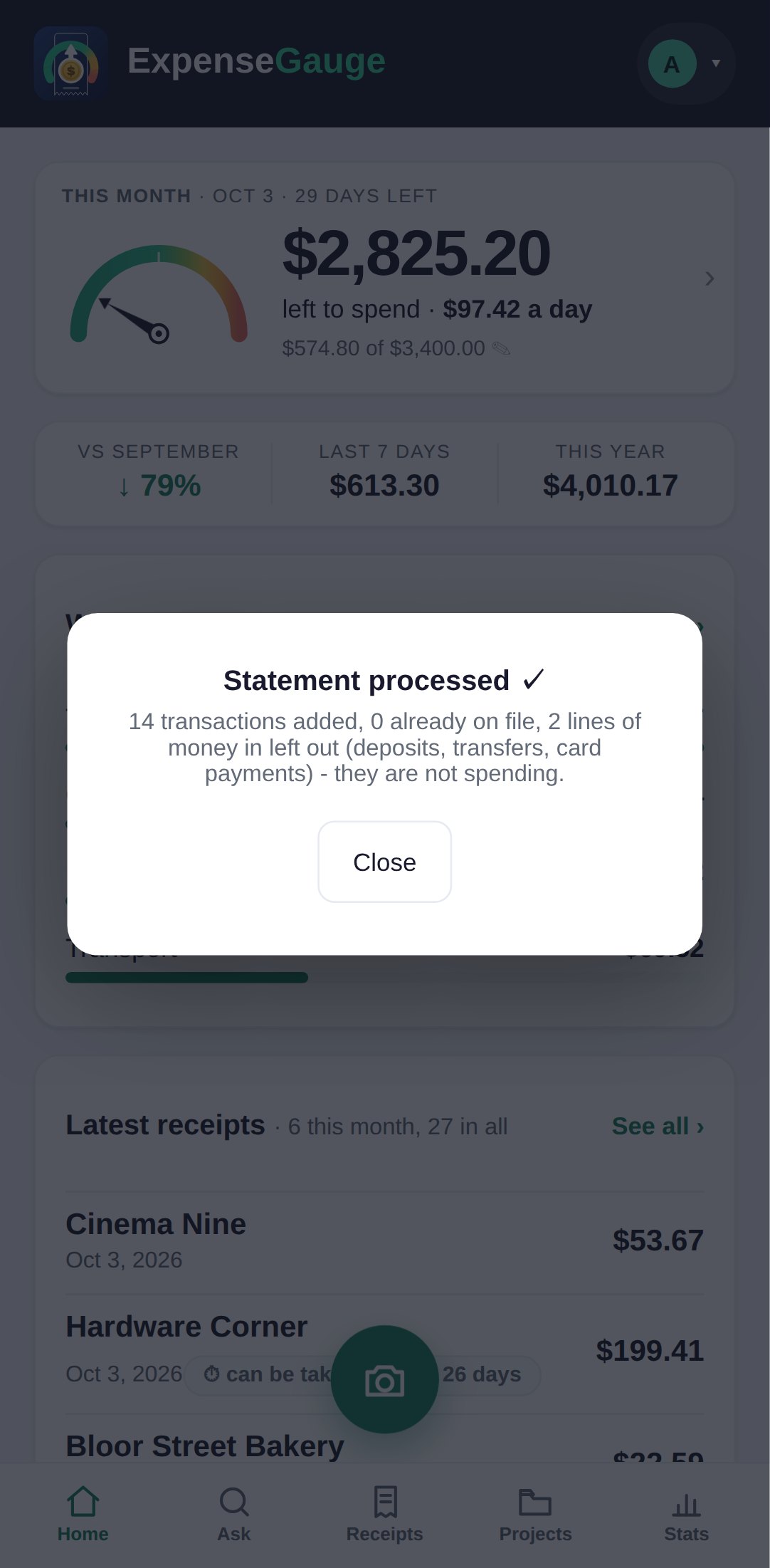
Send ExpenseGauge the PDF or a photo of the page, the same way you send a receipt. Every payment becomes an entry in its category. Deposits, transfers to your own accounts and the payment to your credit card are left out, and a line that matches a receipt you already sent is recognised and not counted twice.
Nothing connects to your bank. You send the page; nobody else ever touches your login. See how statements work for the details.
No password. You sign in with a six-digit code sent to your email. The free plan is not a trial — see pricing.